Table of contents
逆ベッセル多項式
定義
逆ベッセル多項式は、ベッセル多項式を用いて
\[\theta_n (x) \equiv x^n y_n (1/x) = \sum_{k=0}^n \frac{(n+k)!}{(n-k)! k!} \frac{x^{n-k}}{2^k} \tag{1}\]のように定義されます。 \(n = 0, 1, \dots, 5\) の具体的な多項式は、次のようになります。
| \(n\) | \(\theta_n (x)\) |
|---|---|
| \(0\) | \(1\) |
| \(1\) | \(x + 1\) |
| \(2\) | \(x^2 + 3x + 3\) |
| \(3\) | \(x^3 + 6x^2 + 15x + 15\) |
| \(4\) | \(x^4 + 10x^3 + 45x^2 + 105x + 105\) |
| \(5\) | \(x^5 + 15x^4 + 105x^3 + 420x^2 + 945x + 945\) |
またこれらを可視化したグラフは、次のようになります。
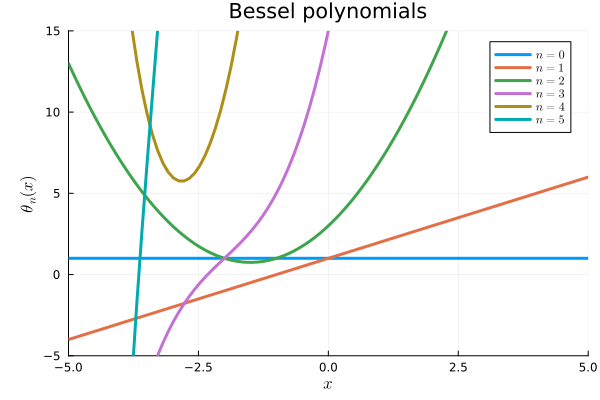
最高次の係数は常に1となることや、\(x = 0\) での値は
\[\theta_n (0) \underbrace{=}_{k = n 以外は全てゼロ} = \frac{(2n)!}{n!} \frac{1}{2^n} = (2n-1)!! \tag{2}\]のように計算できる特徴があります。
半整数次の修正ベッセル関数との関係式
\[y_n (x) = \sqrt{\frac{2}{\pi x}} e^{1/x} K_{n+1/2} (1/x) \tag{3}\]のように与えられるのでした。 これを(1)式に代入すると
\[\theta_n (x) = x^n \sqrt{\frac{2x}{\pi}} e^x K_{n+1/2} (x) = \sqrt{\frac{2}{\pi}} x^{n+1/2} e^x K_{n+1/2} (x) \tag{4}\]のように、逆ベッセル多項式も第二種ベッセル関数を用いてかけることがわかります。 この式と、第二種修正ベッセル関数において \(K_\nu = K_{-\nu}\)が成り立つことから
\[\begin{align} \theta_{-n} (x) &= \sqrt{\frac{2}{\pi}} x^{-n+1/2} e^x K_{-n+1/2} (x) = \sqrt{\frac{2}{\pi}} x^{-n+1/2} x^{-n+1/2} x^{n-1/2} e^x K_{n-1/2} (x) \notag \\ &= x^{1-2n} \theta_{n-1} (x) \tag{5} \end{align}\]も成り立つことがわかります。
逆ベッセル多項式の漸化式
(4)式を修正ベッセル関数が満たす漸化式に代入します。 すると
\[\begin{align} &\sqrt{\frac{\pi}{2}} x^{-n - 3/2} e^{-x} \theta_{n+1} - \sqrt{\frac{\pi}{2}} x^{-n + 1/2} e^{-x} \theta_{n-1} = \frac{2\left( n + 1/2\right)}{x} \sqrt{\frac{\pi}{2}} x^{-n - 1/2} e^{-x} \theta_n \notag \\ &\Longrightarrow \ \theta_{n+1} - x^2 \theta_{n-1} = (2n +1) \theta_n \tag{6} \end{align}\]を得ます。
逆ベッセル多項式が満たす微分方程式
(4)式を修正ベッセル関数が満たす微分方程式に代入しましょう。
\[\begin{align} \frac{d}{dx} K_{n+1/2} &= \sqrt{\frac{\pi}{2}} \left\{ \left( -n - \frac{1}{2}\right) x^{-n-3/2} e^{-x} \theta_n - x^{-n-1/2} e^{-x} \theta_n + x^{-n-1/2} e^{-x} \theta_n' \right\} \notag \\ &= \sqrt{\frac{\pi}{2}} x^{-n-1/2} e^{-x} \left\{ \theta_n' - \left( \frac{n+\frac{1}{2}}{x} + 1\right) \theta_n \right\} \tag{7} \end{align}\] \[\begin{align} \frac{d^2}{dx^2} K_{n+1/2} &= \sqrt{\frac{\pi}{2}} \left[ -\frac{n+\frac{1}{2}}{x} x^{-n-1/2} e^{-x} \left\{ \theta_n' - \left( \frac{n+\frac{1}{2}}{x} + 1\right) \theta_n \right\} - x^{-n-1/2} e^{-x} \left\{ \theta_n' - \left( \frac{n+\frac{1}{2}}{x} + 1\right) \theta_n \right\} \right. \notag \\ & \qquad \left. + x^{-n-1/2} e^{-x} \left\{ \theta_n'' + \frac{n+\frac{1}{2}}{x^2} \theta_n - \left( \frac{n+\frac{1}{2}}{x} + 1\right) \theta_n' \right\}\right] \tag{8} \end{align}\]これらより
\[\begin{align} &\frac{d^2}{dx^2} K_{n+1/2} + \frac{1}{x} \frac{d}{dx} K_{n+1/2} - \left( 1 + \frac{\left( n + \frac{1}{2}\right)^2}{x^2} \right) K_{n+1/2} = 0 \notag \\ & \underbrace{\Longrightarrow}_{\times \sqrt{\frac{2}{\pi}} x^{n+1/2} e^x} \left[ - \frac{n + \frac{1}{2}}{x} \left\{ \theta_n' - \left( \frac{n+\frac{1}{2}}{x} + 1\right) \theta_n \right\} - \theta_n' + \left( \frac{n+\frac{1}{2}}{x} + 1\right) \theta_n + \left\{ \theta_n'' + \frac{n + \frac{1}{2}}{x^2} \theta_n - \left( \frac{n+\frac{1}{2}}{x} + 1\right) \theta_n' \right\}\right] \notag \\ & \qquad \qquad \qquad + \frac{1}{x} \left\{ \theta_n' - \left( \frac{n + \frac{1}{2}}{x} + 1\right) \theta_n \right\} - \left( 1 + \frac{\left( n + \frac{1}{2} \right)^2}{x^2}\right) \theta_n = 0 \tag{9} \end{align}\]のようになります。 式が長いため、\(\theta_n'', \theta_n', \theta_n\) の各係数ごとに計算しましょう。
\[\theta_n'': 1 \tag{10}\] \[\theta_n': - \frac{n + \frac{1}{2}}{x} -1 - \left( \frac{n+\frac{1}{2}}{x} + 1\right) + \frac{1}{x} = - \frac{2n}{x} - 2 \tag{11}\] \[\begin{align} &\theta_n: \frac{n + \frac{1}{2}}{x} \left( \frac{n + \frac{1}{2}}{x} + 1\right) + \left( \frac{n + \frac{1}{2}}{x} + 1\right) + \frac{n + \frac{1}{2}}{x^2} - \frac{1}{x} \left( \frac{n + \frac{1}{2}}{x} + 1\right) - \left( 1 + \frac{\left( n + \frac{1}{2} \right)^2}{x^2}\right) \notag \\ & \qquad = \frac{\left( n + \frac{1}{2} \right)^2}{x^2} + \frac{n + \frac{1}{2}}{x} + \frac{n + \frac{1}{2}}{x} + 1 + \frac{n + \frac{1}{2}}{x^2} - \frac{n + \frac{1}{2}}{x^2} - \frac{1}{x} - 1 - \frac{\left( n + \frac{1}{2} \right)^2}{x^2} \notag \\ & \qquad = \frac{2n + 1}{x} - \frac{1}{x} = \frac{2n}{x} \tag{12} \end{align}\]よって全体に \(x\) をかけることで
\[x \theta_n'' - 2 (x + n) \theta_n' + 2n \theta_n = 0 \tag{13}\]のような、逆ベッセル多項式が満たす微分方程式を得ることができます。
参考文献
[1] Carlitz, 1957, “A note on the Bessel polynomials”
[2] Burchnall, 1951, “The Bessel Polynomials”
[3] Krall & Fink, 1949, “A new class of orthogonal polynomials: The Bessel polynomials”
[4] Wolfram MathWorld, “Bessel Polynomial”